
Music has been a part of my life since I was little. I began studying vocal music at a music academy outside of school when I was in third grade and started developing my skills in solo classical voice performance in high school. Perhaps the thing I love most about music (though it’s hard to choose) is how it brings people together. Whether laboring over difficult repertoire with my classmates in choir or butchering pop songs during karaoke with my friends, music has allowed me to connect with others in a way that nothing else has.
Sharing music is something that has been with humankind for as long as humankind has been around, and in the Hammond-Harwood House a piece of evidence stands as witness to this legacy: an 1806 Broadwood and Son forte piano. When I first saw the instrument in the ballroom, I was awestruck to learn that it is the same model on which Haydn would have played.
There are a few things that distinguish this forte piano from a modern piano. For one, it only has five and a half octaves as compared to the seven and change on an instrument you’d see today. You can hear this difference reflected in the music of Haydn and his contemporaries. As a result of the limited range, it’s important to listen for low notes in piano music of this era; even though they aren’t as deep as something you might hear in more modern piano composition, they were the lowest notes these composers could write.
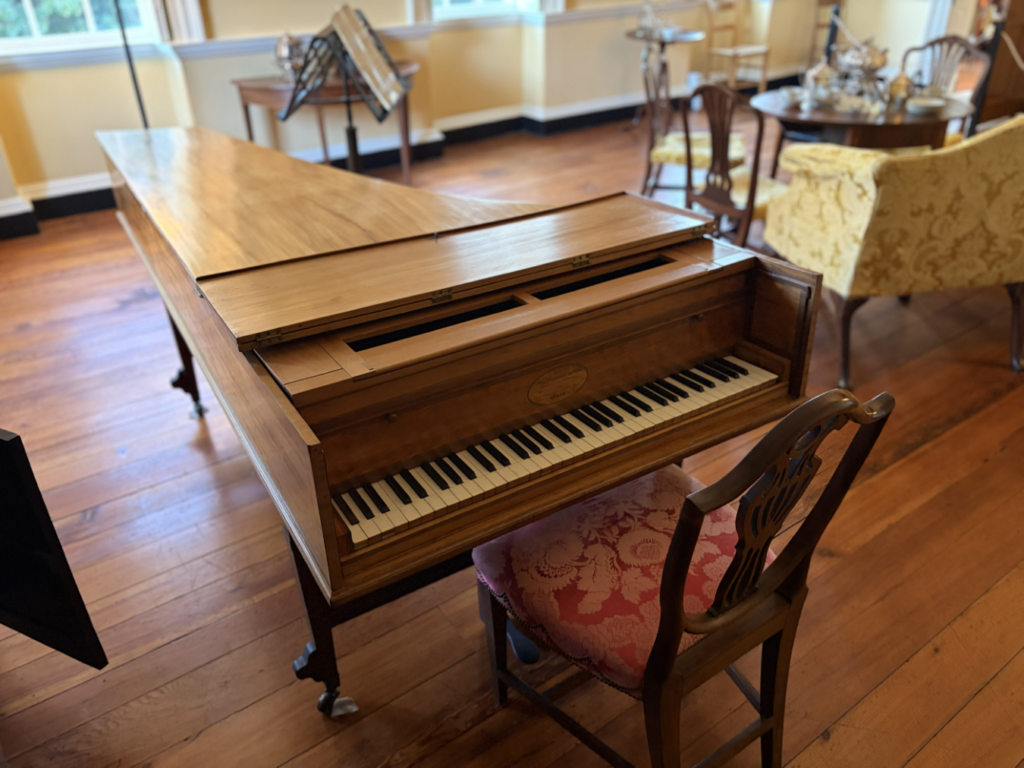
In the 19th-century, the Lockermans would have gathered around an instrument like this at parties to sing songs and entertain one another. This practice was part of a trend that emerged at the turn of the 18th-century when art songs composed for a single voice and piano allowed well-to-do families to bring high culture music into their own homes when previously it was reserved for royal courts and the Church. This style of singing and playing was much more intimate than that of opera with its huge orchestras and equally huge voices, and it allowed performers to express nuanced emotions in a more naturalistic way. Notably, the parts written for piano also gained emotional nuance and independence instead of just existing to provide harmonic support for the voice.
I am currently in the process of rehearsing a piece by Haydn with a friend accompanying me on piano. When I stand in the crook of the significantly more modern instrument and the sound surrounds me, I can feel myself transported to a 19th-century salon singing alongside a forte piano like the one in the ballroom. I count myself lucky that through this object I have access to a tradition that has united people across space and time.
Annika Siegel
Hammond Harwood House Student Aide
