As I write, almost everyone is seeking air conditioned or shady spaces while we are in the thick of high temperatures and humidity–typical Maryland weather for July and August. How did early residents of the Hammond-Harwood House cope with hot weather? Well—they had the advantage of plaster walls, which keeps things cooler. The strict symmetry of the house allowed doors and windows to open to let breezes in. But, how did they amuse themselves? Just as today, they engaged in quiet activities—stitching, card games, music, and the like.
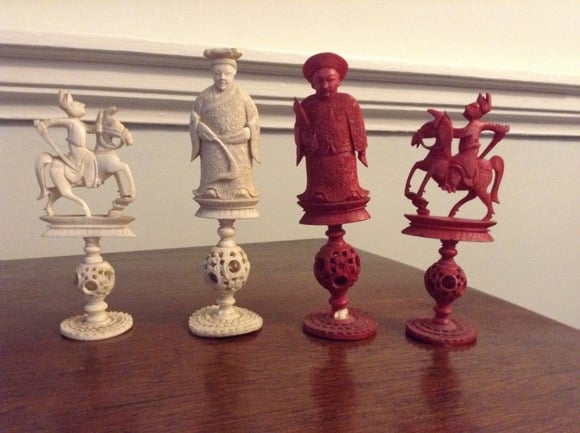
One of the most fascinating objects in our Game Room is the beautiful ivory chess set. Chess has a long history beginning in India and is often called “The Royal Game” because so many monarchs from India, Persia, Asia, continental Europe and Great Britain, were avid fans. In fact, the terms “check” and “check mate” come from the Persian words “Shāh” for the king, or “Shāh Māt” for the king is helpless.
One of the “virtues” of the game (if you can call it that), is that it relies on intellect and not mere chance. Many prominent early American statesmen played chess, including Thomas Jefferson, who considered it one of his favorite games. There are records of him teaching his granddaughter Ellen how to play, as well as accounts of purchase and repairs to his chess sets. Jefferson played with Benjamin Franklin, James Madison, Aaron Burr, and in Paris, with the Duchess of Bourbon Bathilde d’Orléans, who was reported to equal his skill.
The Hammond-Harwood House chess set is created from Indian ivory. One part of the set is natural ivory while the red color opponent is also ivory dyed, most likely from dried cochineals (tiny red insects from Central and South America, Dactylopius coccus). Besides the age of our set, which is early nineteenth century, the intricate carving and striking color make it a set to be admired. Come visit the house and see our Game Room before anyone declares “Shāh Māt”!
Lucinda Dukes Edinberg, Curator