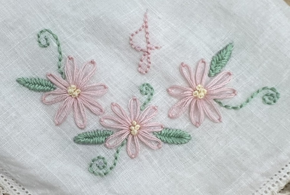
I was going through some family linens a couple of weekends ago and re-discovered some exquisite embroidery from the early part of the 20th century. This led me to resurrecting a book from our library titled, Jane Austen Embroidery, by Jennie Batchelor and Alison Larkin. For Jane Austen, needlework was both a social and useful activity. There was “plain-work,” which was the making of household linens and other utilitarian needs, and there was ornamental work. Middle-class women in the Georgian period were expected to be accomplished needleworkers. Austen refers to ornamental needlework in her novels Emma and Northanger Abbey, as well as Pride and Prejudice, where Fanny Price and Elizabeth Bennet are much more skilled than Lady Bertram and Lady Catherine. Austen also writes about the prices of fabrics and fashion and repurposing clothes, in what would be, in modern parlance, “upcycling.” Patterns could be found in magazines such as the Lady’s Magazine; or Entertaining Companion for the Fair Sex, which circulated in Europe and America in the late 18th century.
Many people associate embroidery, quilting, and similar handwork, with a woman’s occupation of the past—and it certainly was an important role since women of all classes were in charge of providing clothing and linens for their household. Girls were taught to use the needle at an early age. There were arguments from some who viewed needlework as pure drudgery and that it deflected from a women’s proper education. Austen was able to combine her enjoyment of needlework with her skills as a writer.
Today, these skills are developed more in leisure than as a necessity, but modern textile artists use a variety of hand stitching techniques. There are so many motifs and threads in beautiful colors of cotton and silk that can be adapted to today’s fashions and the creativity of these artists who adapt old designs and add their own personal flair is inspiring.